Elry HQ · your customer portal
Handing over a process shouldn’t mean losing sight of it
When we automate and run a process for you, you get HQ: one secure place to see how the work is going, what it’s producing, and everything we’ve agreed. You can check it yourself, any time, without having to take our word for it.
Describe the process Your questions answered ↓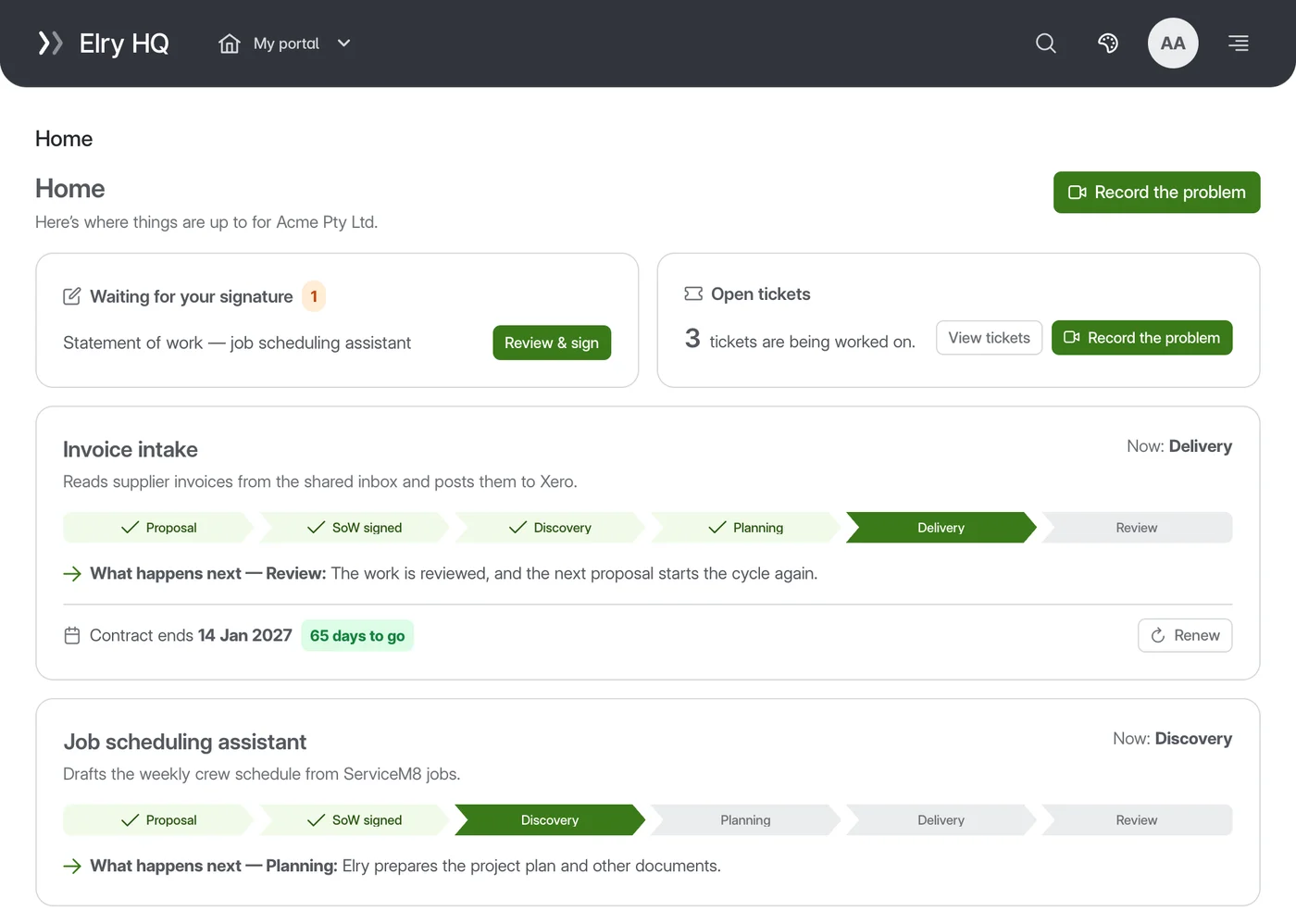
Sample data. A customer's home page: what's waiting on you, what we're working on, and where each automation is up to.
We run our own company on the systems we sell. Behind that sits a decade of operating critical infrastructure: a major Australian university’s identity system, 780,000+ accounts without downtime, and platforms in production at some of Australia’s largest mining operations. Meet the team.
The questions owners ask before handing over a process
They're fair questions. Here's how HQ answers each one.
“Once it's built, I won't know what's going on.”
You see the progress, then the results
While we build, HQ shows each stage, from proposal and signed scope through discovery, planning and delivery to review, with the date each was reached and when the next is due.
Once it’s live, each month’s delivery report is in HQ: what the automation processed, how accurately, and the time it saved. Anything the automation can’t handle goes to a person, and every action it takes is logged.
We count value honestly. The assessment measures your baseline before anything is built. Cash removed, capacity released and risk reduced are different things, and we price only what we can agree. The service is then reviewed every year against real outcomes.
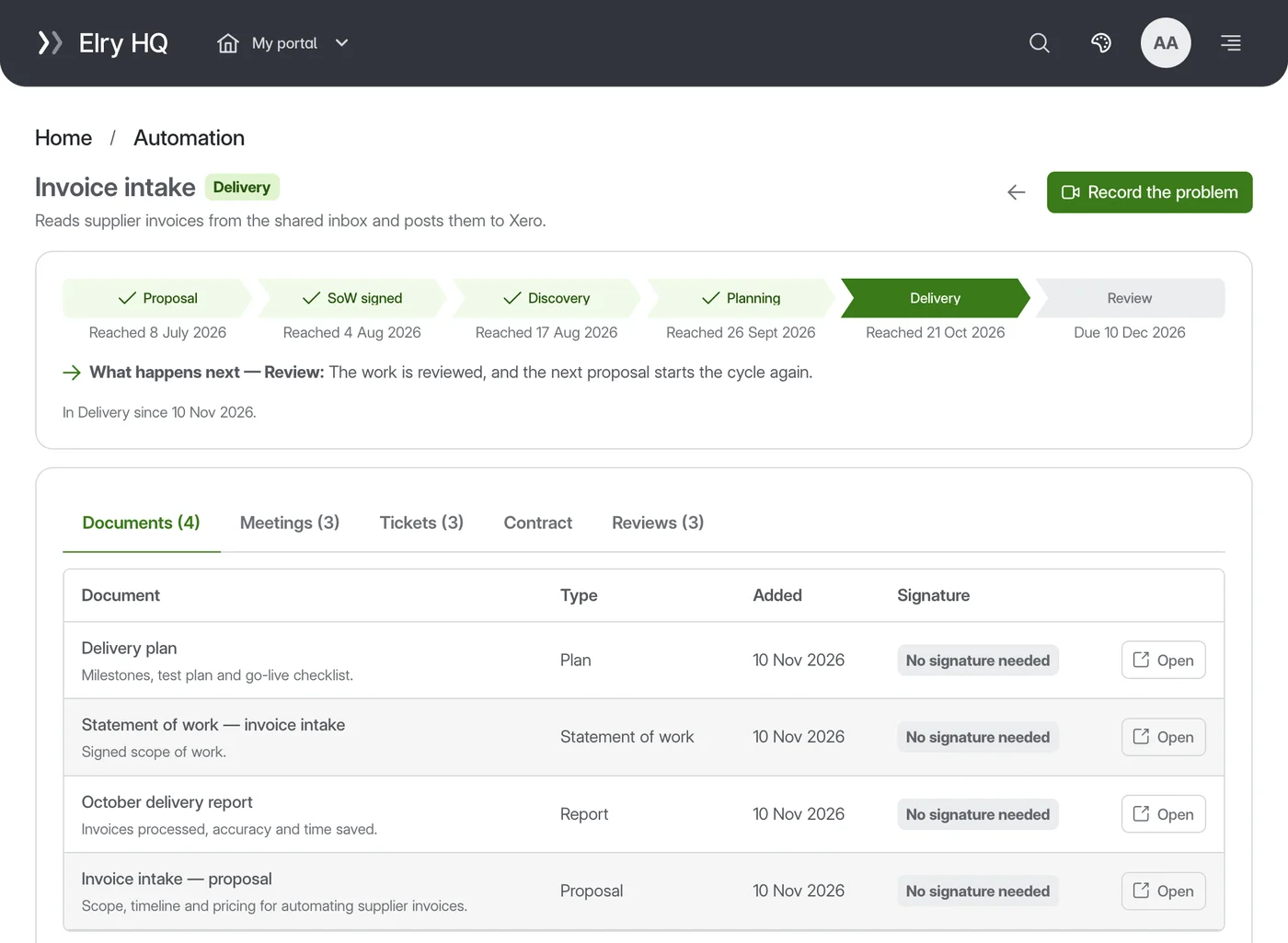
Sample data. Every stage is dated, and the October delivery report sits with the automation it reports on.
“What gets built won't do what we agreed.”
"Working" is defined before you pay an ongoing fee
The acceptance test is agreed before we build anything. It defines “working” in your terms: real inputs, real volumes, checked outputs. No ongoing fee exists until it passes.
Proposals and statements of work are signed in HQ. HQ records who signed and when, against the exact version of the document, so nobody can later swap in a different one.
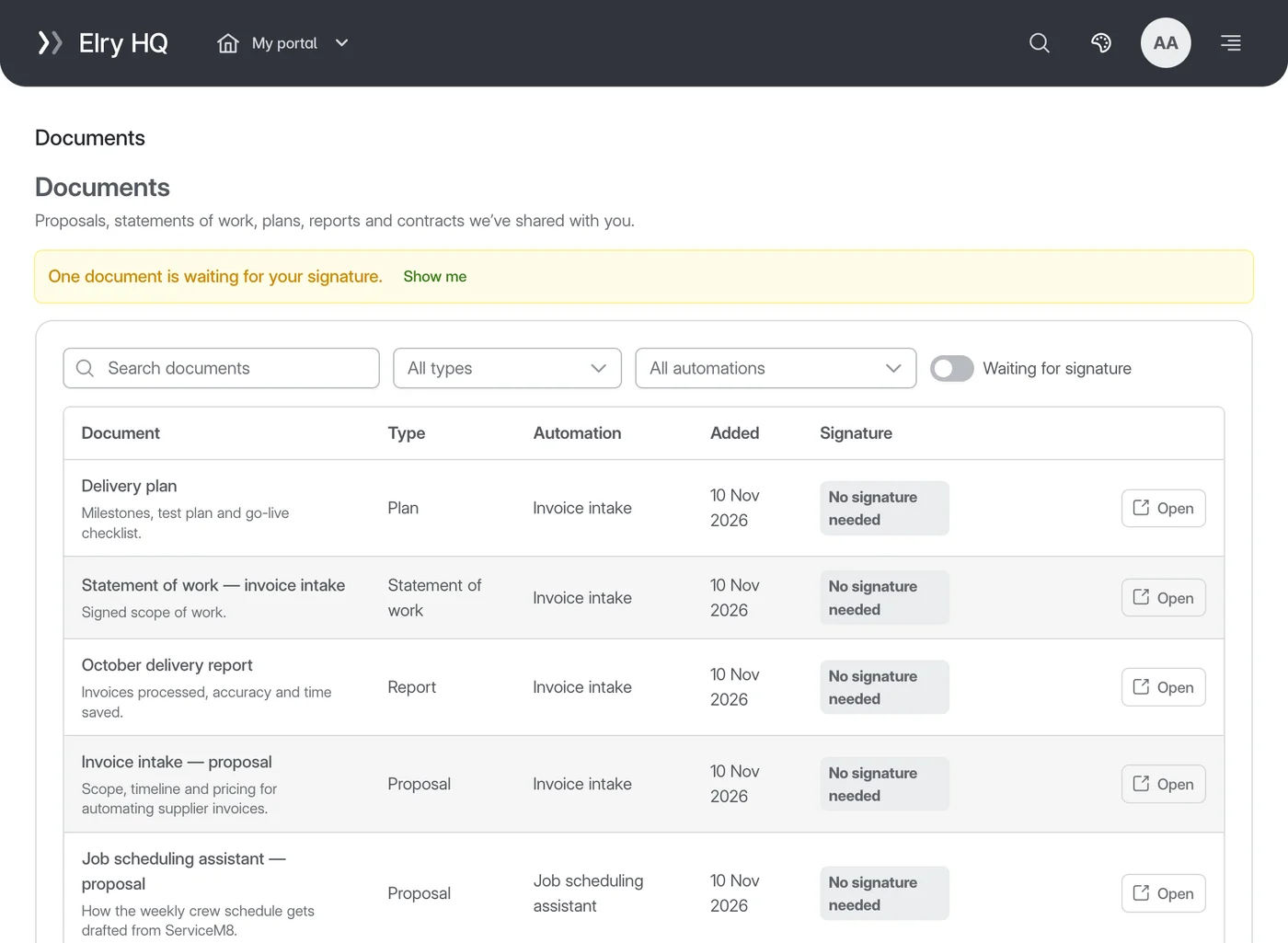
Sample data. Every proposal, signed scope, plan and report in one place, with anything waiting on you flagged at the top.
“When something breaks, I'll be chasing someone for days.”
You don't have to be the one who notices
Monitoring is part of what the monthly fee buys, so problems are watched for, not left for you to find. Incidents have defined severities and response targets, written into your agreement, and a named service owner is accountable for your automation.
If you spot something, press Record the problem, show us what’s on your screen and talk us through it. It becomes a ticket in our work queue, so nobody has to describe it twice. You can type it instead if you’d rather.
- Each ticket’s status in HQ updates as we work on it: open, in progress, in review, closed
- Ask for changes the same way. A workflow change allowance is part of the monthly fee
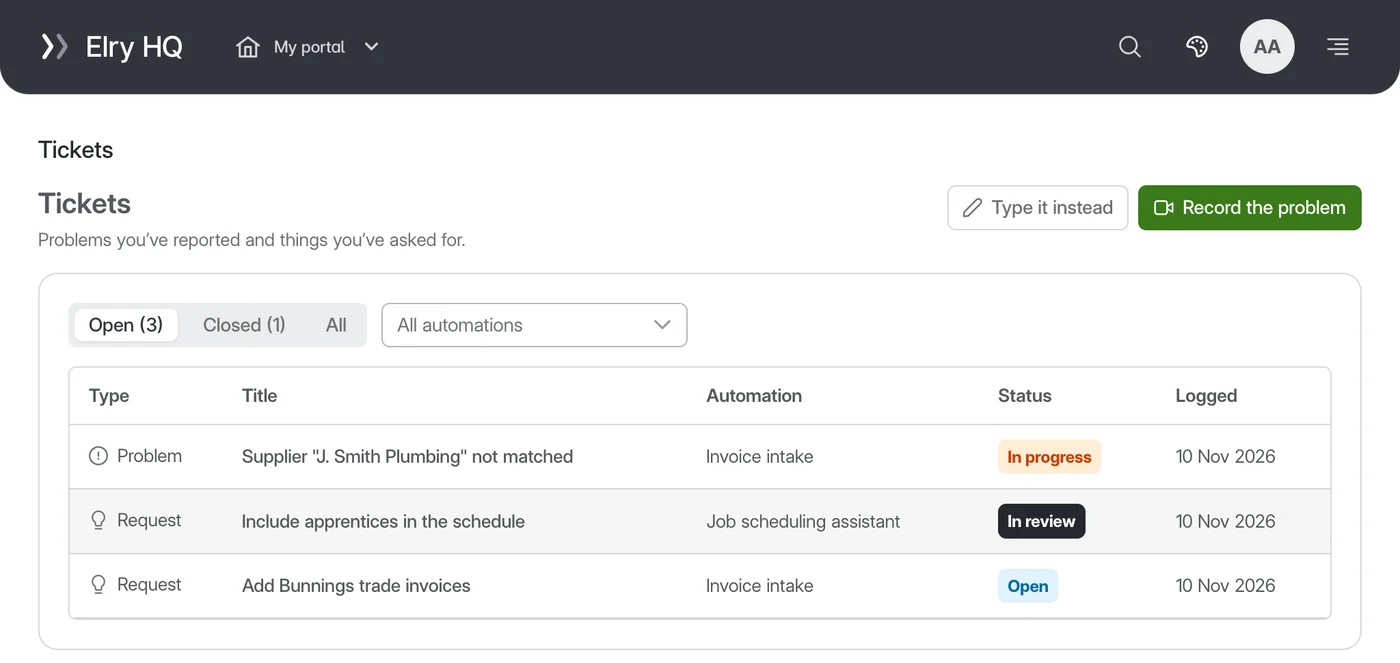
Sample data. Problems and requests, each with its live status.
“If your key person leaves, the knowledge leaves with them.”
Your automation has a named owner, and a written record
A named service owner is accountable for your automation. Everything they know about it is recorded, not remembered: the documented system, the signed scope, and the recordings, transcripts and notes from every call, kept in HQ and sorted by automation.
If they’re unavailable, a developer bench beyond the principals works from that same record.
- A standing backup and patching cadence
- Professional and cyber insurance behind the engagement
- The contractual right to export your data, configuration and process logic at any time
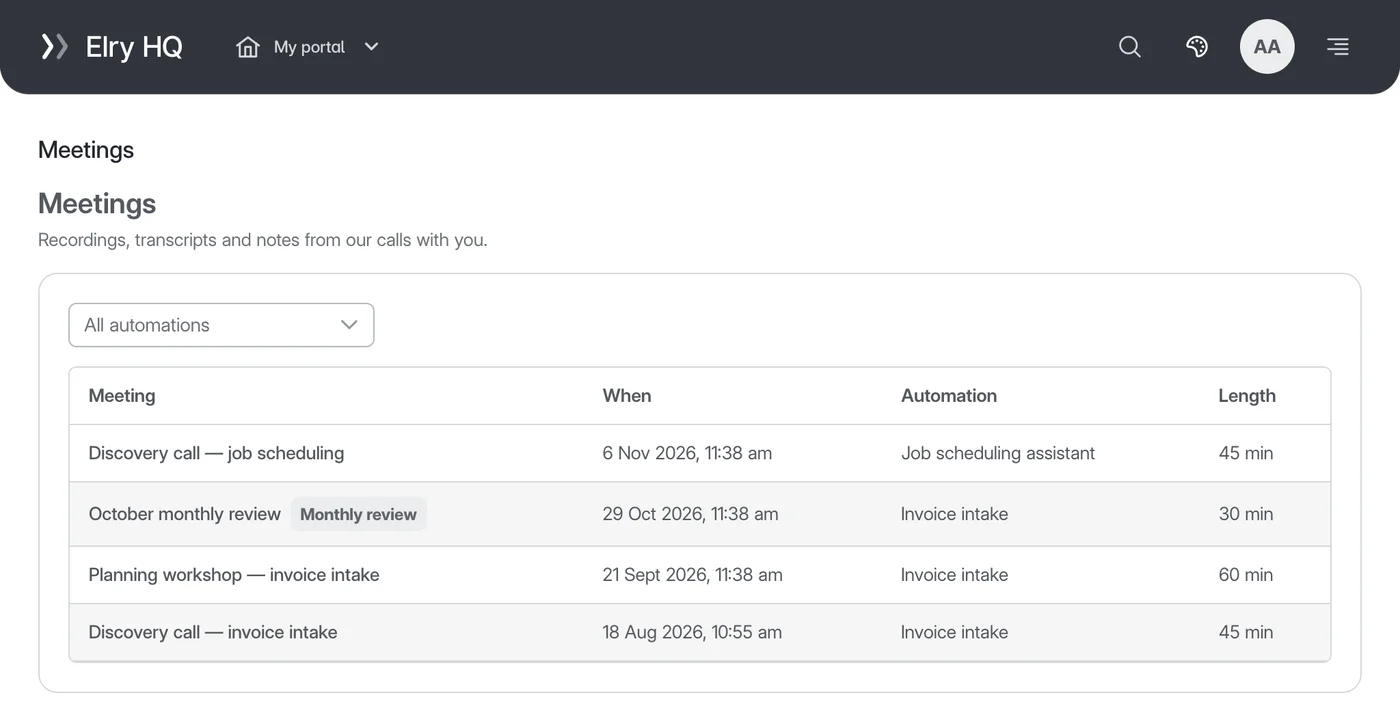
Sample data. Every call, kept and sorted by automation.
“I don't want AI making decisions in my business.”
Most of your process won't run on AI at all
The predictable steps run as fixed, tested software, giving the same result every time. AI does only the work that genuinely needs judgment, such as reading a document that arrives in a different layout each time. The business calls stay with your people.
Fixed rules for the predictable work
Matching, calculating, posting and sending run as tested software, the same way every time.
AI output is checked before it leaves
Where AI is used, its output passes checks before anything reaches your customers or your systems, and anything it can’t handle goes to a person.
“You'll stop caring once the contract's signed.”
You tell us how we're going, and we watch for it slipping
Each month HQ asks you to score each automation out of 10, and say what went well and what could be better. It takes about a minute.
Between reviews, HQ checks every night how each customer’s work is tracking, using your feedback and our own delivery record. A decline is flagged to our team, so it’s picked up then, not at the next scheduled review.
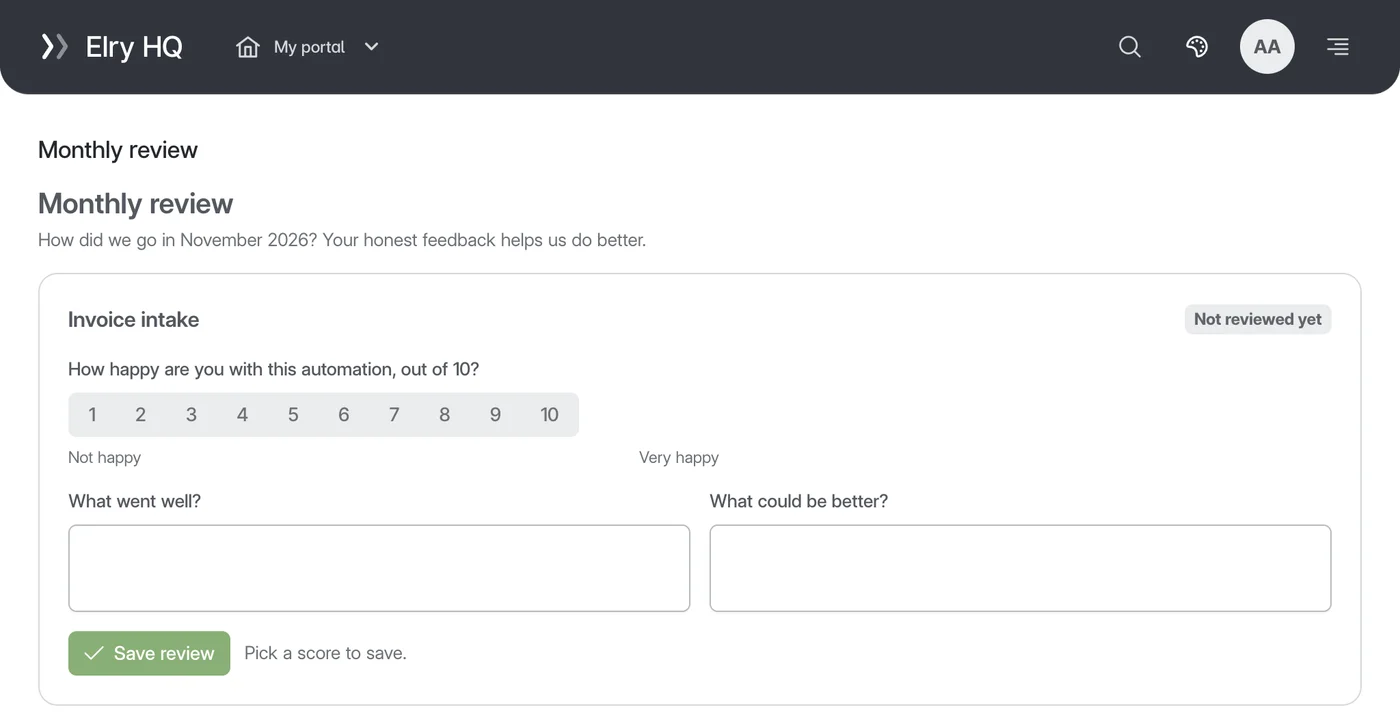
Sample data. The monthly review: a score and two short answers.
“We'll be locked in.”
Twelve months, then your call every year
There’s a twelve-month minimum. After that, notice is 60 days rolling, and the service is reviewed every year against real outcomes. We re-earn the fee every year. Your home page in HQ shows when each contract ends, so the decision never sneaks up on you.
Take everything with you
Your data, configuration and process logic are exportable at any time, and your documents can be downloaded from HQ whenever you like.
Then we remove it
When you leave, what we hold is removed from our systems, so take your copy before you go.
“Who can see our data?”
Your data stays yours, and you know where it goes
HQ and the automations it reports on hold the details of how your business runs. Here’s how they’re protected. Read our security and data handling.
Walled off from other customers
Every record in HQ is tied to your business. Other customers can’t see it, and nothing can be moved into their accounts.
Only the people you nominate
There’s no public sign-up for HQ. We invite each person on your team. On our side, access is limited to the people who operate the service, and every action is logged.
Hosted in Australia
HQ’s database and files are hosted in Sydney, and recordings are transcribed on our own hardware in Australia. Your primary business data lives in Australia too.
Every path mapped before you commit
Every proposal includes a data-flow map showing exactly which services touch your business data, including any offshore processing or metadata path, before you agree to anything.
Screens on this page show sample data, not a real customer.
Bring one process. We’ll tell you if it’s worth automating.
Describe it in four questions and we’ll come back with a straight answer, plus how you’d track it in HQ. Managed operation starts from $2,500 per month plus GST, and begins only after the acceptance test passes. Prefer to see HQ first? Book a 30-minute conversation and we’ll show you it working with sample data.
Worth a 30-minute conversation.